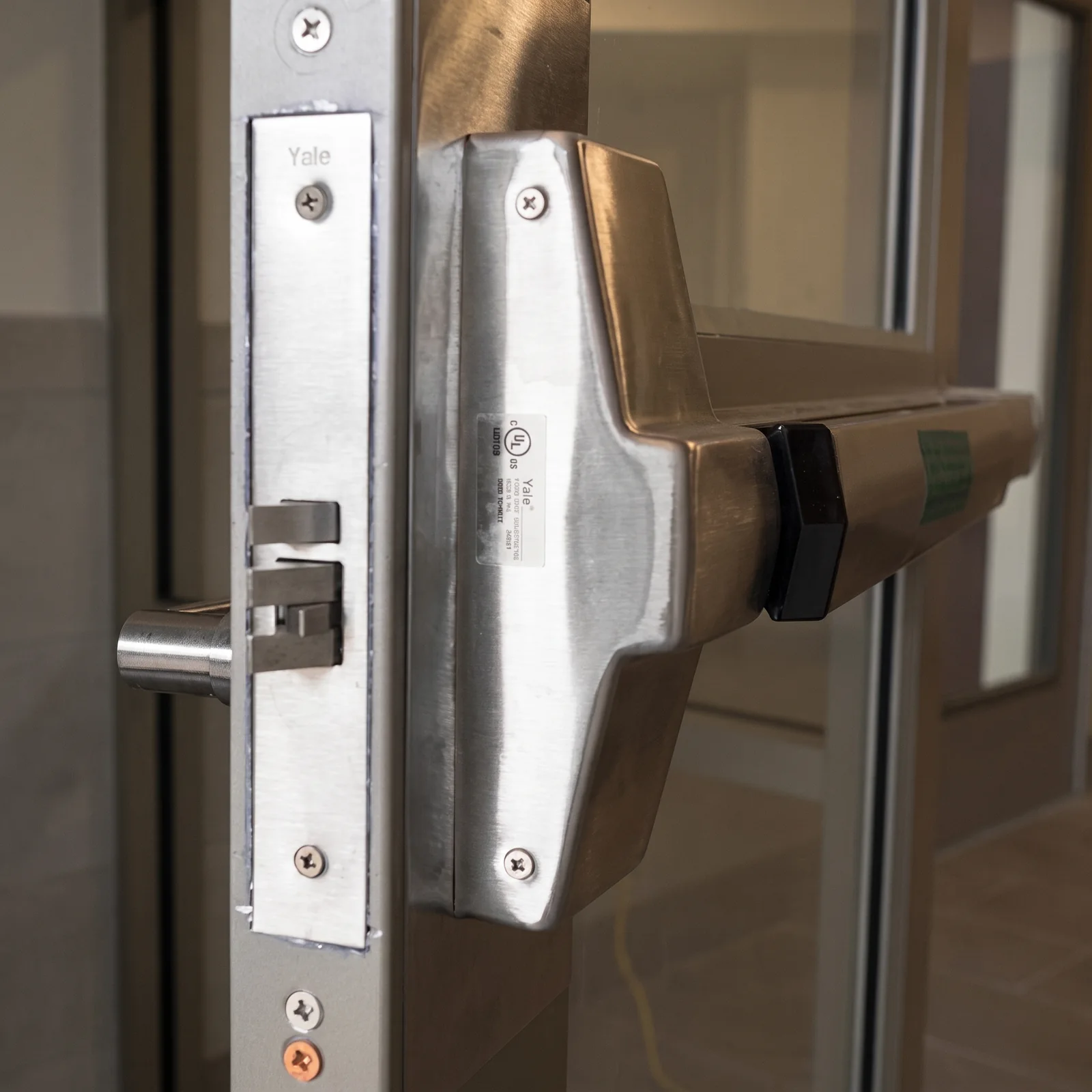
Panic Bar & Exit Device Repair in Washington DC

Panic Bar & Exit Device Repair

Reliable Panic Bar & Exit Device Repair in DC

DC Commercial Door Solutions repairs and replaces panic bars and exit devices on commercial buildings throughout Washington, DC. This service is for property owners, facility managers, and businesses whose exit doors have a push bar, crash bar, or exit device that has stopped latching, feels loose, or has failed outright.

Panic Bar & Exit Device Repair - DC Commercial Door Solutions

Panic Bar & Exit Device Service Overview

A panic bar, also called a crash bar or exit device, lets people leave a building quickly by pushing a horizontal bar rather than operating a knob or lever. Because these devices sit on egress doors, a malfunctioning unit is both an inconvenience and a security or life-safety concern. We diagnose, adjust, repair, and replace panic bars and exit devices on commercial entrances, stairwell doors, and other egress points.

Types of Exit Devices We Work On

  • Rim exit devices — mounted on the surface of the door, the most common type on single doors and pairs with a mullion.
  • Mortise exit devices — the latch mechanism is recessed into the door edge, typically paired with a mortise lock cylinder.
  • Vertical rod exit devices — rods run along the face or inside the door to engage latches at the top and bottom, common on pairs of doors without a center mullion.
  • Electrified and access-control-compatible exit devices — panic hardware wired into an access control or alarm system. See our access control systems page for how these integrate.

Common Panic Bar & Exit Device Problems

Why won't my panic bar latch?

A panic bar that won't latch is usually caused by strike or frame misalignment, a worn or broken latch, a bent push rail, or loose mounting screws that have let the whole assembly shift out of position. Vertical rod devices can also fail to latch if a rod has come loose or the door has sagged.

Why does the door feel loose or rattle when pushed?

Loose mounting hardware, worn internal springs, or a chassis that has cracked from repeated heavy use are the most frequent causes. This is typically a repair rather than a full replacement unless the housing itself is damaged.

Can a broken push bar be repaired?

Often, yes. Many push bar failures come down to worn internal components, a broken spring, or a damaged touchpad that can be replaced without swapping the entire device. A cracked chassis or a device that no longer holds adjustment usually calls for full replacement instead.

Repair Process

We start by testing the device under normal use to identify whether the problem is alignment, hardware wear, or a failed internal mechanism. From there we adjust strikes and rods, tighten or replace mounting hardware, and repair or swap worn components. If the device itself has failed structurally or no longer meets the door's application, we'll recommend and install a suitable replacement exit device.

Repair vs. Replacement

Alignment problems, loose hardware, and worn latch components are almost always repairable. Replacement becomes the better option when the chassis is cracked, the device is significantly outdated for the door's current fire or life-safety application, or repeated repairs haven't held. On fire-rated doors, any replacement exit device needs to be rated appropriately for that opening — see our fire-rated doors page for more on that topic.

Properties We Serve

Panic bars and exit devices are required on egress doors in most commercial occupancies — we service them for office buildings, retail stores, restaurants, apartment and condominium buildings, and other commercial properties throughout the DC area.

Serving Washington DC

We repair and replace panic hardware for commercial properties across Washington, DC, including buildings in Downtown DC, Capitol Hill, and NoMa, where office and mixed-use buildings rely on exit devices to stay code-compliant on egress doors.

Related Services

Frequently Asked Questions

Why won't my panic bar latch?

A panic bar usually fails to latch because of strike or frame misalignment, a worn or bent latch, or loose mounting hardware that has let the device shift. Vertical rod devices can also lose latching when a rod disconnects or the door has sagged.

Can a panic bar be repaired?

Yes, in most cases. Alignment issues, loose hardware, and many internal component failures can be corrected without replacing the whole unit. Replacement is typically needed only when the chassis is cracked or the device has failed structurally.

What is the difference between a panic bar and an exit device?

"Panic bar" and "exit device" are generally used interchangeably. Panic bar (or crash bar) typically refers to the horizontal push bar itself, while "exit device" is the broader term covering rim, mortise, and vertical rod hardware that provides push-to-exit function on egress doors.

Can panic hardware work with access control?

Yes. Electrified exit devices can be integrated with access control systems so the door stays secured from the outside while always allowing free egress from the inside by pushing the bar. See our access control systems page for more detail.

When should an exit device be replaced instead of repaired?

Replacement makes sense when the housing or chassis is cracked, the device repeatedly falls out of adjustment after repair, or the current hardware isn't rated correctly for the door's application, such as a fire-rated opening.

Do vertical rod and rim exit devices repair the same way?

The core diagnostic approach is similar, but vertical rod devices have additional components — the rods and top/bottom latches — that rim devices don't, so alignment and rod adjustment are specific to that hardware type.

Contact DC Commercial Door Solutions

If a panic bar or exit device on your property isn't latching, feels loose, or has failed, call DC Commercial Door Solutions at (202) 517-2407 or request a free quote below.

Go To Top